
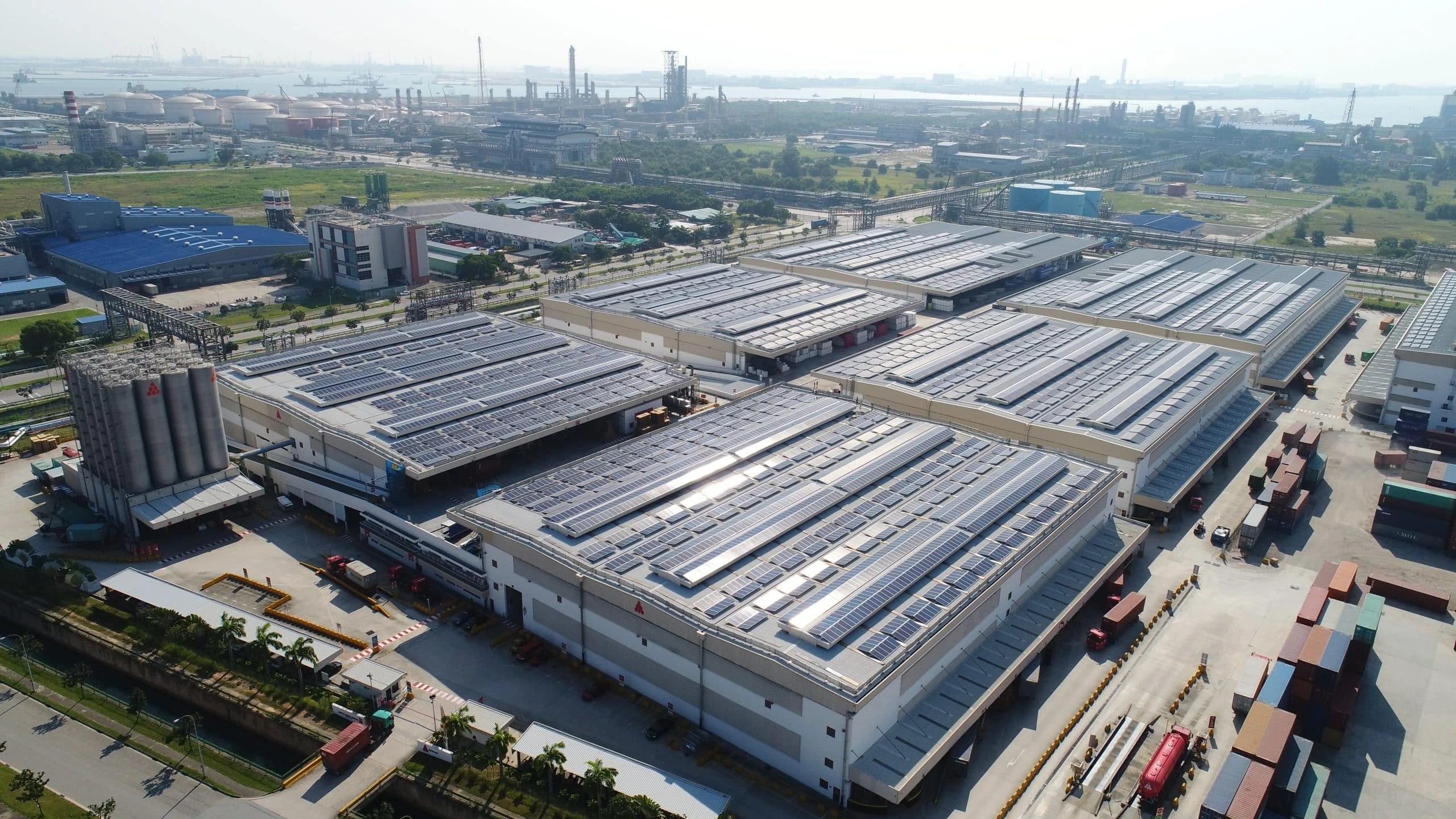
Commercial solar panel Return on Investment (ROI) in Singapore is calculated by dividing your annual financial benefits — including electricity bill savings, grid exports, and REC sales — by your upfront engineering and installation capital expenditure (CAPEX).
For commercial and industrial facilities operating across the island, a custom-engineered rooftop photovoltaic (PV) system delivers an average payback period of 3 to 5 years, and an expected 25-year lifetime return exceeding 300% to 500%.
As Singapore accelerates its deployment to achieve a 3 Gigawatt-peak (GWp) solar target by 2030, businesses are also facing fast increasing electricity tariffs. Forward-thinking corporations are shifting from passive utility consumption to active on-site generation to mitigate volatility in electricity costs.
As Singapore’s most experienced turnkey solar engineering pioneer, Energetix details exactly how to calculate, optimise, and secure your facility’s financial returns below.
1. The Core Variables Driving Commercial Solar ROI in Singapore
Calculating an accurate commercial solar ROI requires mapping five precise localised inputs against your facility’s operational schedule.
ROI (%) = [ Annual Savings + Grid Export Revenue + REC Sales ] ÷ CAPEX × 100
Initial Capital Expenditure (CAPEX)
Commercial solar installation costs in Singapore typically range between S$0.80 and S$1.20 per Watt. This varies depending on your building’s electrical network, roof type (such as concrete decks or metal sheets), and safety access.
Expected Energy Output
Singapore’s near-equatorial location provides high, consistent solar irradiance year-round, and well-designed rooftop systems typically achieve an annual specific yield of 1’150 to 1’300 kWh per kWp. Actual output, however, is site-specific. The following factors can meaningfully shift a system’s real-world performance and are worth assessing at the design stage:
- Shading from nearby buildings, rooftop equipment (water tanks, lift motor rooms, cooling towers), or trees, which can disproportionately reduce output across an entire string, not just the shaded panel.
- Soiling and dust: particulates from industrial exhaust such as shipbuilding or nearby construction activity can reduce output if panels are not cleaned when required.
- Panel degradation: modules typically lose around 0.4% to 0.6% of rated output per year, which should be factored into long-term yield projections.
- System design and inverter sizing: the DC-to-AC ratio, string configuration, and cable losses all affect how much of the generated energy is delivered to your meter.
A proper site assessment accounts for all these variables up front, rather than relying on a single blended yield assumption for every roof.
High-Value Electricity Offsets
Commercial entities in Singapore face fluctuating retail electricity tariffs that sit between S$0.15/kWh and S$0.30/kWh. Because commercial operations usually peak during peak sunlight hours, every kilowatt-hour your roof generates directly offsets energy consumed. This translates to immediate, dollar-for-dollar operational savings.
Monetising Excess Energy: The Enhanced Central Intermediary Scheme (ECIS)
Facilities with low energy demand can export surplus power back to the national grid. Under the EMA Enhanced Central Intermediary Scheme (ECIS), businesses can sell excess PV generation back to the grid, turning otherwise unused daytime sunlight into a secondary revenue stream.
Renewable Energy Certificates (RECs)
Every megawatt-hour (MWh) of clean power your system generates produces one tradable certificate. Local and multinational corporations buy these certificates to offset their Scope 2 emissions, opening a supplemental market revenue stream.
2. Singapore Commercial Solar ROI Matrix
| Metric / Variable | Typical Range / Value | Impact on Corporate Financials |
|---|---|---|
| Average Payback Period | 3 to 5 years | Rapid transition from asset depreciation to pure operational profit. |
| Internal Rate of Return (IRR) | 15% to 22% | Outperforms standard capital investments and fixed deposits. |
| System Lifespan | 20+ years | Delivers predictable, inflation-protected utility forecasting. |
| Turnkey Asset Costs | S$0.80 – S$1.20 per Wattpeak | Scalable based on roof area and structural traits. |
| REC Asset Trading Yield | S$15 – S$25 per MWh | Provides alternative cash generation to accelerate payback. |
3. Step-by-Step Financial Breakdown
To demonstrate the formula in practice, consider a hypothetical industrial facility in Tuas or Changi equipped with a 500 kWp (kilowatt-peak) system.
Step 1: Establish Total Initial Investment
- System capacity: 500 kWp
- Avg CAPEX rate: S$0.90/Wp
- Total investment: S$450’000
Step 2: Project Annual Asset Yield
Singapore’s tropical climate generates roughly 1’250 kWh of energy per year for every kWp installed.
- Annual output: 500 kWp × 1’250 kWh = 625’000 kWh / year
Step 3: Compute Annual Financial Inflow
Assuming your facility directly uses 80% of the generated PV electricity while navigating a retail tariff of S$0.20/kWh, with the remaining 20% exported at an export tariff of S$0.15/kWh:
- Gross savings: 80% × 625’000 kWh × S$0.20 = S$100’000
- Export earnings: 20% × 625’000 kWh × S$0.15 = S$18’750
- REC earnings: 625’000 kWh × S$0.02 = S$12’500
- Net annual return: S$131’250
Step 4: Returns Calculations
- Simple annual ROI: (S$131’250 ÷ S$450’000) × 100 = 29.1%
- Payback window: S$450’000 ÷ S$131’250 = 3.4 years
4. Engineering-Led Asset Optimisation With Energetix
Most generic solar calculators miss the technical variables that dictate actual financial returns. At Energetix, our engineering-led design approach ensures your system matches your building’s unique requirements:
- Data-driven returns calculation: we study your energy consumption data to determine the proportion of PV electricity consumed and exported, giving a reflective calculation of expected savings and returns.
- Navigating local regulations: our project teams manage all required SP Group grid connections, SCDF fire safety approvals, and PV structural roof load assessments.
- Proven track record: Energetix manages prominent commercial and industrial solar developments across Southeast Asia, including a 6 MWp commercial rooftop installation for Jurong Port–RMC, Changi Airport Group’s solar installation across Terminal 3 and 4 and a 23 MWp ground-mount system, and projects for clients including DHL, GSK, Mapletree, and DSV (formerly DB Schenker).
Frequently Asked Questions
How is commercial solar ROI calculated in Singapore?
ROI is calculated as: [Annual Savings + Grid Export Revenue + REC Sales] ÷ CAPEX × 100. Annual savings come from offsetting electricity you would otherwise buy from the grid, grid export revenue comes from surplus power sold under schemes like ECIS, and REC sales come from trading the certificates your system generates — all measured against your upfront capital expenditure.
What is the average payback period for commercial solar in Singapore?
Most commercial and industrial rooftop systems in Singapore pay back within 3 to 5 years. The worked example in this guide — a 500 kWp system in Tuas or Changi — shows a 3.4-year payback based on a 29.1% simple annual ROI.
What kind of long-term returns can a business expect?
Commercial systems typically deliver an Internal Rate of Return (IRR) of 15% to 22%, well above standard capital investments and fixed deposits, with a 20+ year system lifespan and an expected 25-year lifetime return exceeding 300% to 500%.
How much does a commercial solar installation cost in Singapore?
Turnkey commercial solar costs typically range from S$0.80 to S$1.20 per Watt, depending on your building’s electrical network, roof type (concrete deck versus metal sheet), and site access for installation.
How much electricity will my system generate?
Well-designed rooftop systems in Singapore typically achieve an annual specific yield of 1’150 to 1’300 kWh per kWp, though actual output is site-specific — shading, soiling, panel degradation (around 0.4% to 0.6% per year), and inverter sizing can all shift real-world performance.
Can my business earn money by exporting excess solar electricity?
Yes. Facilities with low on-site demand can export surplus generation to the grid under the EMA’s Enhanced Central Intermediary Scheme (ECIS), turning otherwise unused daytime generation into a secondary revenue stream on top of direct electricity savings.
What are Renewable Energy Certificates (RECs) and what are they worth?
Every megawatt-hour of clean power your system generates produces one tradable REC, which local and multinational corporations buy to offset their Scope 2 emissions. REC trading typically averages S$15 to S$25 per MWh, giving businesses a supplemental revenue stream that accelerates payback.
Ready to Map Your Facility’s True Energy Value?
To build an accurate financial model for your commercial roof space, reach out to our team at info@energetix.sg or WhatsApp / call us directly at +65 6394 9349, or get in touch here.
To help us accelerate your personalised financial model, please share:
- Your building’s site location and/or building roof drawings
- Your last 3 months’ monthly electricity bills
- Your building lease period